9. Money

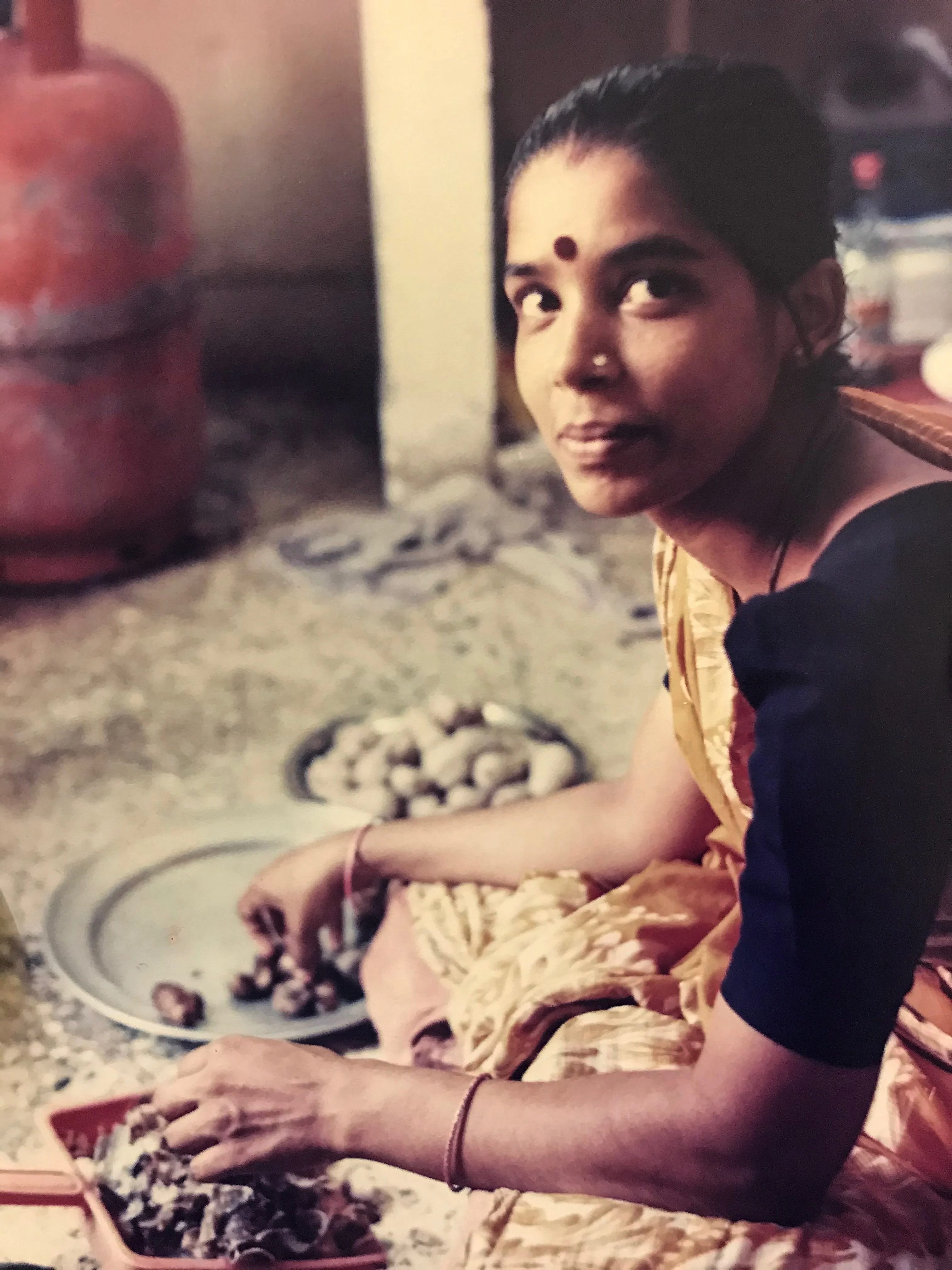
My father passed away while we were writing these chapters. I’m feeling guilty. What kind of daughter am I? I have a house, I have three bedrooms; in the house, we have our yoga center. I have an income, I have help, I have food. But I never took Ayya in to live here with us.
People are just as ignorant now as they were when I was a child. Everybody keeps away from lepers, isolates them. But even I did that. Otherwise, no one would come for class in this house again, and we can’t afford that.
[Listen to the audiobook podcast version here.]
[Content warning: Domestic violence.]
But it makes me so angry to think how much every turn in my life has been about money: having too little money, or no money at all, losing money, someone else having a lot of money. I had to marry Gurusamy because my parents couldn’t afford a dowry. And I had to drop out of school to clean the houses of rich men like Kumar who would abuse me.
I saw him this past January when we spent a week driving around the countryside and mountains of southern Tamil Nadu, my husband, me, and Ilari. My childhood villages have changed a lot in the last thirty years. Even Kulathur is looking wealthier now, though where my relatives live is still a shantytown. The tiny shack we lived in when I was a toddler — me, my mother, her siblings, grandma and thatha, all under one roof — is still there, empty. But here and there you see a few big houses, some built by the untouchables whose land has risen in value, some by the government. In Bodi, too, most of the people I knew back in my childhood still live in the same place, on all the same streets they used to, but their old homes have been torn down and replaced by taller stone buildings.
Kumar had moved from Bodinayakanur to the city of Theni nearby. When we called at his place, he invited us inside to sit with the family. Surely he must have had some idea why we showed up. But there was nothing in particular I wanted to say to the old man; it was enough for me to visit him, just so he will remember what he did to me, and to show him he couldn’t break me. He looked just as slick and odd as I remembered, just as restless and lazy, only more wrinkled. And exactly the same hairstyle, though he dyes it nowadays.
And Karnan, also fat and grey now. We visited their house too, in Bodinayakanur, sat with him and his wife drinking Fanta in their living room. Walls covered with pictures of their guru Sai Baba smiling next to their family members, mostly Karnan’s late father, the one who took turns with his son trying to force me into sex. Karnan’s memory was very sharp when it came to my family in the olden days, or my mother and father, our neighbors and friends — but he kept saying he couldn’t really remember me. He seemed much more nervous than Kumar was.
“That was his wife, right?” Ilari asked me as we left the house.
“His second wife,” I told him. “He killed the first one.”
Nothing had happened to him, of course, because rich people don’t go to jail, unless maybe their families want them to go. Karnan had hit his wife Selvi on the head with a rolling pin, then took her body into the bathroom where he set it on fire with kerosene to make it look like suicide. That’s a very common way women in Bodi kill themselves. I was still in school then, in first or second standard, but already working in their house with my mother.
Selvi-akka was someone who always showed respect to the servants looking after her house and children. We were very close to her, my mother and I; she called my mom “Akka”, and I was “Maheswari-papa” to her. She would help me with my schoolwork sometimes, and taught me reading and writing and maths; and I babysat her children, a three-and-a-half-year-old girl and two-year-old boy. That mostly meant playing with them, and I felt like Selvi-akka looked at me as their big sister.
On the morning of that day, something felt wrong when I woke up.
“Mayes, get up, go go! Six o’clock already, sunlight is coming!”
“I don’t want to go.”
“Why? Selvi-akka needs to send you to the marketplace!”
Usually, I was at their house early before school to make the kolam, and my mother never had to tell me — I was happy to go, especially because I knew Selvi-akka would give me coffee or snacks when I came. But now I wanted to stay home, I don’t know why.
Only when Amma hits me and yells I finally get up. “Get going! She’s waiting!”
I start getting ready, rubbing my bum where she smacked me, unhappy and tired, when my mother notices a man running up our street, going from door to door and asking: “Which one is Vellayammal’s house? Where does she live?”
“I am Vellayamma. What is it?”
“Selvi-akka has passed!” the man says. “Suicide!” And we all run over to their place.
When we get there, there are many people around the house, children crying, lots of police. They won’t let us inside. “I don’t want to see her, I don’t want to see her…” my mother keeps repeating as the ambulance arrives. I can’t keep it in; I’m crying and shouting, we both are.
After a long wait, we are allowed to go in. All the family is there, grandma, grandfather, Karnan’s siblings, police officers talking to them in low voices, asking questions, while my amma is cleaning up and serving coffee. Karnan is sitting in his chair, crying. I’m on the floor, holding his children in my lap. They are both crying. The girl’s voice is hoarse; she is wailing as she listens to the grown-ups answering the policemen’s questions, and through her tears she gets out: “I saw Appa hit Amma with a poori kattai!”
One of the relatives walks over — it was Karnan’s sister, I think — and picks her up. “Okay, okay,” she says, and as she walks out of the room with the crying child in her arms, I remember something too. I run into the kitchen.
“Amma, I also saw something last night!”
“Shush,” she says. Her eyes are red from crying.
“But Amma! Akka and Anna were having a fight last night before I left, and her face was so sad!”
“Just shut up!” she says and flicks me hard on the forehead. “Go home!”
“What, why?”
“Because,” my mother whispers in my ear, sounding angry for some reason, “because it’s almost six o’clock and that is when Selvi-akka might come back as a ghost, okay?”
That was a terrifying thought, so I left. A few days later, the family moved to another place, in the area around the cardamom factories. They owned two or three houses and they didn’t want to stay in a place where a family member had died like that — though my mother had scared me with the ghost story just so I would stop talking. She loved Selvi-akka, but it was always better to stay out of trouble.
Later, Karnan’s mother asked my mom if I could keep taking care of her grandson and granddaughter. So I kept working for the family, because I was close to the children and because we needed the money. We all knew what had happened, but rich people can do what they want. The morning after, Karnan had made it look like his wife had been making breakfast in the morning, then killed herself only after he already left the house, and that was the story he told. But men don’t know what to do in the kitchen, and Karnan had tried to make coffee with the husks left from when she had roasted coffee seeds. So everyone could tell.
But poor people can also get away with killing their relatives, if they are all poor enough. Who would pay any mind? The police don’t care. And what else can you do with old people who are suffering, their bodies covered in bedsores, who can barely eat or move or speak? I remember being very little and a watching someone pour water from a bucket on the face of an old man, out on the street back in Kulathur. There were no hospitals for old people, or doctors to take care of them, no medicine to make the pain go away. Oh, I thought, they are giving the thatha a bath. But he was being drowned, a mercy killing.
Before my father’s death, I used a lot of the yoga class money to try and keep him comfortable, but it wasn’t enough. I would go and see him at the hospital, hold his hand, talk to him. He couldn’t answer me, half of his body was paralyzed and he was in a lot of pain. They didn’t take good care of him at the hospital — many times, his room smelled terrible, and once they didn’t even notice he had urinated and defecated in his bed. For the first time since the thing with Gilid and my mother, and second time in my life, I saw my father cry.